
Courtney Yohe Savage, MPP
Savage Health Policy, LLC
The Resource-Based Relative Value Scale (RBRVS) rests on a principle that no part of the valuation process enforces. Every service’s value is supposed to be relative to every other service’s value. No step in the process tests whether that is true.
Consider what testing it would require. The Physician Fee Schedule holds 6,671 services. To check one value against the schedule, you would have to hold all 6,671 in mind at once. Nobody can do that. So the process substitutes what is actually performable: value one service at a time, against a handful of comparators someone selects. Every local check in the current system is a reasonable answer to an impossible assignment.
The result is a schedule that has drifted toward the one thing it can measure. The statute defines physician work as time and intensity. Time is observable. Intensity is not. Time alone now explains 81 percent of the variation in work values.
Birds
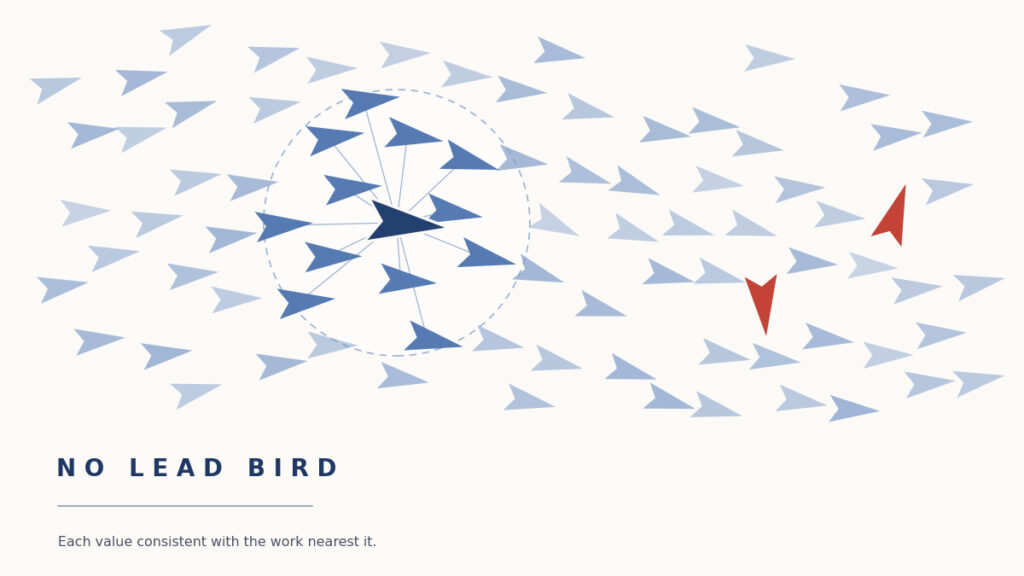
In 1987 Craig Reynolds showed that a flock needs no leader, no plan, and no bird that can see the whole flock. It needs each bird to follow three rules about the neighbors it can see: keep clear of them, match their heading, and stay with them. Flocking is not designed. It emerges. He called his simulated birds, “boids.”
So what happens when we treat the schedule as the flock? First we have to give every service a position assigned by the character of its work rather than by what it is paid. Then we have to state the rules.
Reynolds’ three map onto a fee schedule with one structural difference. A flock never lands. A fee schedule is meant to settle each year once policies are implemented. Two of the three therefore become conditions a settled schedule either satisfies or violates, and the third governs only motion.
Rule One – Local consistency (boids – cohesion): Similar work carries similar intensity per minute, which is the work value divided by the intraservice time. The current fee schedule and RUC survey data provide insights into code similarity that informs starting positions. From there, a flow in motion requires a code to steer toward the center of the “flockmates” it can see. A service’s value must be consistent with the intensity per minute of the services near it, applied to its own time. Time is the multiplier, as the statute defines it, so duration never masquerades as similarity.
Rule Two – Rank Order (boids – separation): Within a family of related services whose own descriptions attest an order, one more extensive than another, the values must keep that order. Birds may not pass through each other. Values may not cross, and an inversion is the collision. This one is a candidate rule rather than a settled one. Extracting those attested orders at scale is unfinished work, and the rule stays subordinate to measured position, because an order enforced between two wrongly placed services would only propagate their error.
Rule Three – has no analog at rest (boids – alignment): Velocity matching is a rule about motion, and in a settled schedule nothing moves. It belongs to the running stage. When values are adjusted, neighboring corrections move at matched rates, so a region of the schedule moves together rather than one service at a time.
One principle runs through all three rules. A service’s position comes from descriptions of the work itself and never from the value assigned to it, because the assigned value is the thing being tested. There is no anchor, and there cannot be one. In flocking there is no lead bird.
This is not an exotic idea borrowed from birds. Logistics, robotics, and internet routing all run on published local rules with no entity seeing the whole system. A schedule of 6,671 values is a smaller flock than the ones industry already trusts to these principles.
So what does this new RBRVS get us? First, a test. Local consistency is a condition the current schedule either satisfies or violates. We can run that test today and assess each service independently to see if it is consistent with its comparables. Every answer comes with the list of services the value was checked against, so anyone can audit it. That is what it means for relativity to be checked rather than asserted.
Second, rulemaking you can see through. With rules stated, CMS could model a proposed policy, run it against the whole schedule, and publish the projected result before adopting it. Comment would address the projected outcome of a stated policy rather than thousands of individual values whose combined impact nobody can see.
Third, a path for genuinely new services. A new service needs two things: a position, which clinicians can judge from the service itself, and its own measured time. Its value follows from the work nearest it. No constituency required, and no negotiation. The rules cut the other way too. A proposed value that cannot be justified against comparable work stops surviving on advocacy alone.
I filed all of this with CMS on September 9, answering the Request for Information in the calendar year 2027 Physician Fee Schedule proposed rule, which asked what objective alternatives exist to the current committee processes. The comment runs 29 pages, reports what the test found, and lists every public source the work was built from. It is posted here. Reference
Craig W. Reynolds, “Flocks, Herds, and Schools: A Distributed Behavioral Model,” Computer Graphics 21, no. 4 (SIGGRAPH ’87 Conference Proceedings, July 1987): 25–34, https://www.red3d.com/cwr/papers/1987/boids.html.